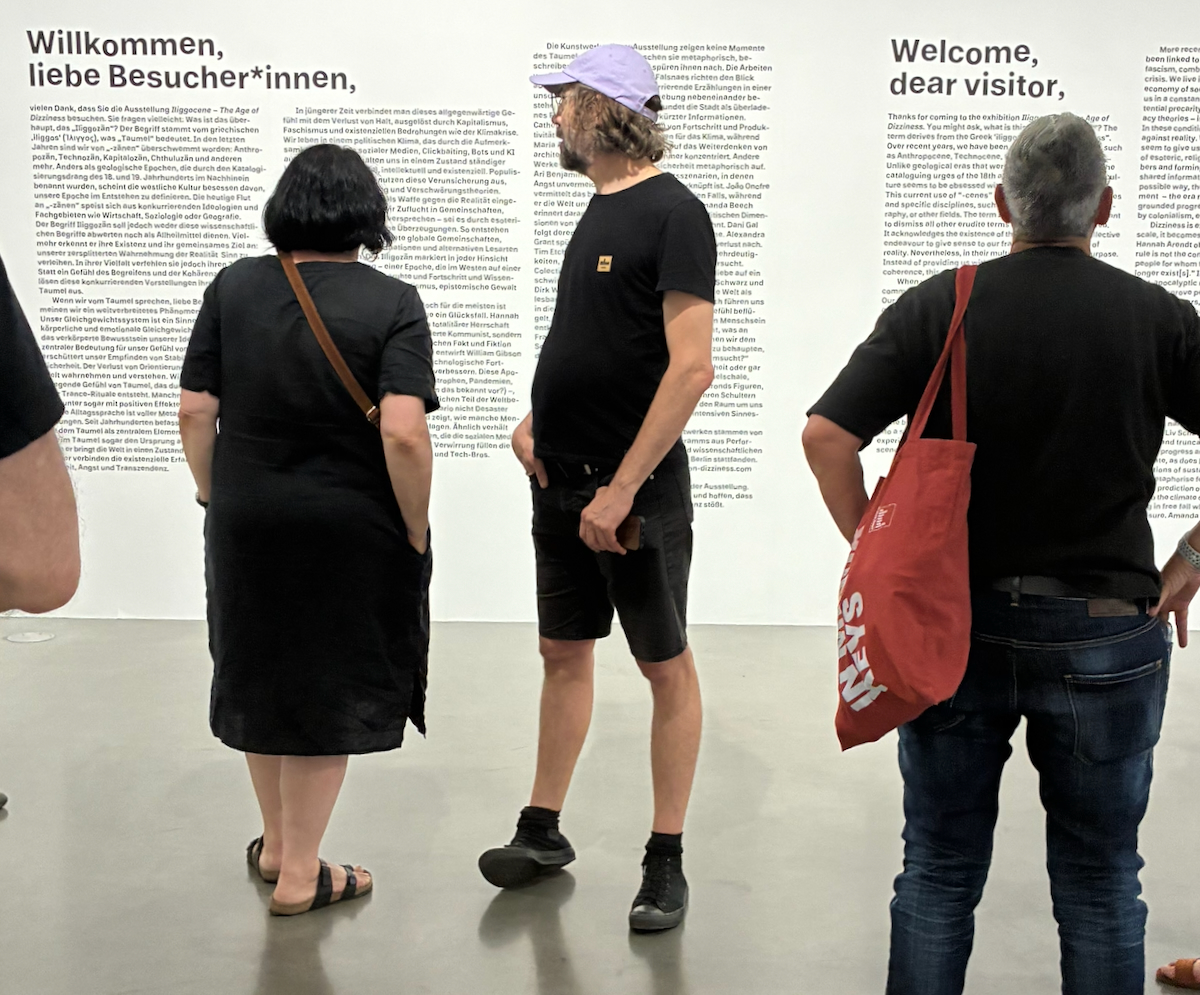
Thanks for coming to the exhibition Iliggocene – The Age of Dizziness. You might ask, “What is this term, Iliggocene?” The term derives from the Greek iliggos ( Ίλιγγος) – “dizziness.” Over recent years, we have been swamped with “-cenes”, such as Anthropocene, Technocene, Capitalocene, Chthulucene... Unlike geological eras that were defined in retrospect by the cataloguing urges of the 18th and 19th centuries, Western culture seems to be obsessed with defining our epoch “on the go”. This current use of “-cenes” is driven by competing ideologies and specific disciplines or schools of thought, such as economics, sociology, geography, or other fields. The term Iliggocene, however, is not meant to dismiss all other erudite terms nor to serve as a panacea. It acknowledges the existence of these terms and their collective endeavour to give sense to our fragmented experience of reality. Nevertheless, in their multiplicity, they fail their purpose. Instead of providing us with a sense of understanding and coherence, this chorus of competing visions makes us dizzy.
When we speak of dizziness, dear visitor, we refer to a common physiological condition with which we are all familiar. Our vestibular system is a sensory organ that supports physical and emotional equilibrium, orientation, and a sense of self; it is central to our embodied experience of balance. Dizziness undermines our sense of stability, grounding, and certainty. Losing our orientation changes our perception and comprehension of the world. We know that feeling of dizziness induced by inebriation, whether through drinking, partying, or trance rituals. Becoming dizzy may be a personal choice with a potential positive impact.
Metaphorising somatic sensations is a common practice in daily language. Indeed, over centuries, philosophers have examined dizziness as a foundational element in their analysis of what it means to be human. Plato understood dizziness even as the beginning of all philosophising: it destabilises the world into a state of uncertainty. Others connect the existential experience of dizziness to freedom and anxiety, as well as transcendence.

More recently, this pervasive sensation of dizziness has been linked to the loss of grounding induced by capitalism and fascism, combined with existential threats such as the climate crisis. We live in a political climate inflamed by the attention economy of social media, clickbaiting, bots, and AI. These keep us in a constant state of existential, emotional, and even intellectual precarity, which then – fuelled by gaslighting and conspiracy theories – is exploited by populism and authoritarianism. In these conditions, the word “fake” is being deployed constantly against reality. We then tend to shelter in communities that seem to give us certainty and clarity, for instance, in the shape of esoteric, religious, or political beliefs, creating “echo chambers” and forming unexpected global communities based on shared information and “alternative” readings of reality. In every possible way, the Iliggocene marks the end of the Enlightenment – the era relying on an ideological rationality that foregrounded progress and science in the “West”, albeit one fuelled by colonialism, epistemic violence, and imperialism.
Dizziness is experienced individually, but on a generalised scale, it becomes a disaster for most and a bonanza for the few. Hannah Arendt observed that “the ideal subject of totalitarian rule is not the convinced Nazi or the dedicated Communist, but people for whom the distinction between fact and fiction … no longer exist[s].” In The Peripheral, William Gibson describes a post-apocalyptic reality in which technological development fails to improve people’s lives. This “apocalypse” sees a mix of climate disasters, pandemics, famines, and wars (does this sound familiar?) happening over an extended period that wipes out a significant part of the world’s population. Gibson does not call this apocalypse a disaster or a calamity – but “the Jackpot”, stressing that with every disaster, some people are making a profit. Likewise, as expressed and pursued in the infamous algorithms that regulate social media, our dizziness and confusion are the profits of some politicians, corporations, and tech bros.
The artworks in this exhibition do not illustrate instances of dizziness. Instead, they metaphorically, descriptively, or associatively explore and seek out such states. The works of Eiko Grimberg and Christian Falsnaes look at the urban fabric, where competing narratives live alongside a fuzzy or degraded context, while Liv Schulman explores the city as an overloaded field of partial and truncated input. Catherine Yass criticises the dogma of progress and productivity for its devastating impact on the climate, as does María Auxiliadora Gálvez Pérez, focusing on questions of sustaining architecture through debris. Other works metaphorise feelings of uncertainty – like Ari Benjamin Meyers’s prediction of the future – with its inevitable anxiety connected to the climate crisis, or João Onofre’s exhilarating feeling of being in free fall while trying to make sense of the world and its measure. Amanda Beech reminds us that dizziness resides inside the politics of communication and language, and Dani Gal follows their reverberations into the realm of dreams. Alexandra Grant traces dizziness by referencing the state of losing control. Tim Etchells opens up instances of agency and ambiguity, which Marcus Steinweg tries to map out for us. Colectivo Los Ingrávidos accelerate our love of order to a dizzying pace, while Stefanie Schwarz and Dirk Wachowiak challenge our need to perceive the world as legible. Cao Fei and Warren Neidich bring us to our digital reality, which provides momentum for imagination and freedom, as well as a space of anxiety and turmoil. It would seem that even in the digital realm, we cannot escape being human, resonating with Frantz Fanon’s existential question: “...can we escape becoming dizzy? And who can affirm that vertigo does not haunt the whole of existence?”
Still, other works try to bring a centring, even reassuring feeling – like Ana Prvački’s support shell whispering words of comfort, or Anderwald + Grond’s people who, like the Greek Titan Atlas, want to carry the world on their shoulders. Likewise, Daniel Meir’s sound piece makes the whole space resonate around us, putting the viewer in the centre of the sensorial experience it emanates.
The text pieces you will encounter among the artworks are interventions by the participants of an extensive programme of performances, concerts, as well as theoretical and scientific lectures, taking place here and in other venues around Berlin. You can see all these events here: www.on-dizziness.com and on Instagram: @iliggocene
Again, thanks for coming to see the exhibition; we are glad to have you and hope the idea of Iliggocene resonates with you.
Deep breaths,
Ruth, Sergio, and Leo